Why Innovation Is Hard in L&D (And What Actually Helps)
By Mark Diaz |
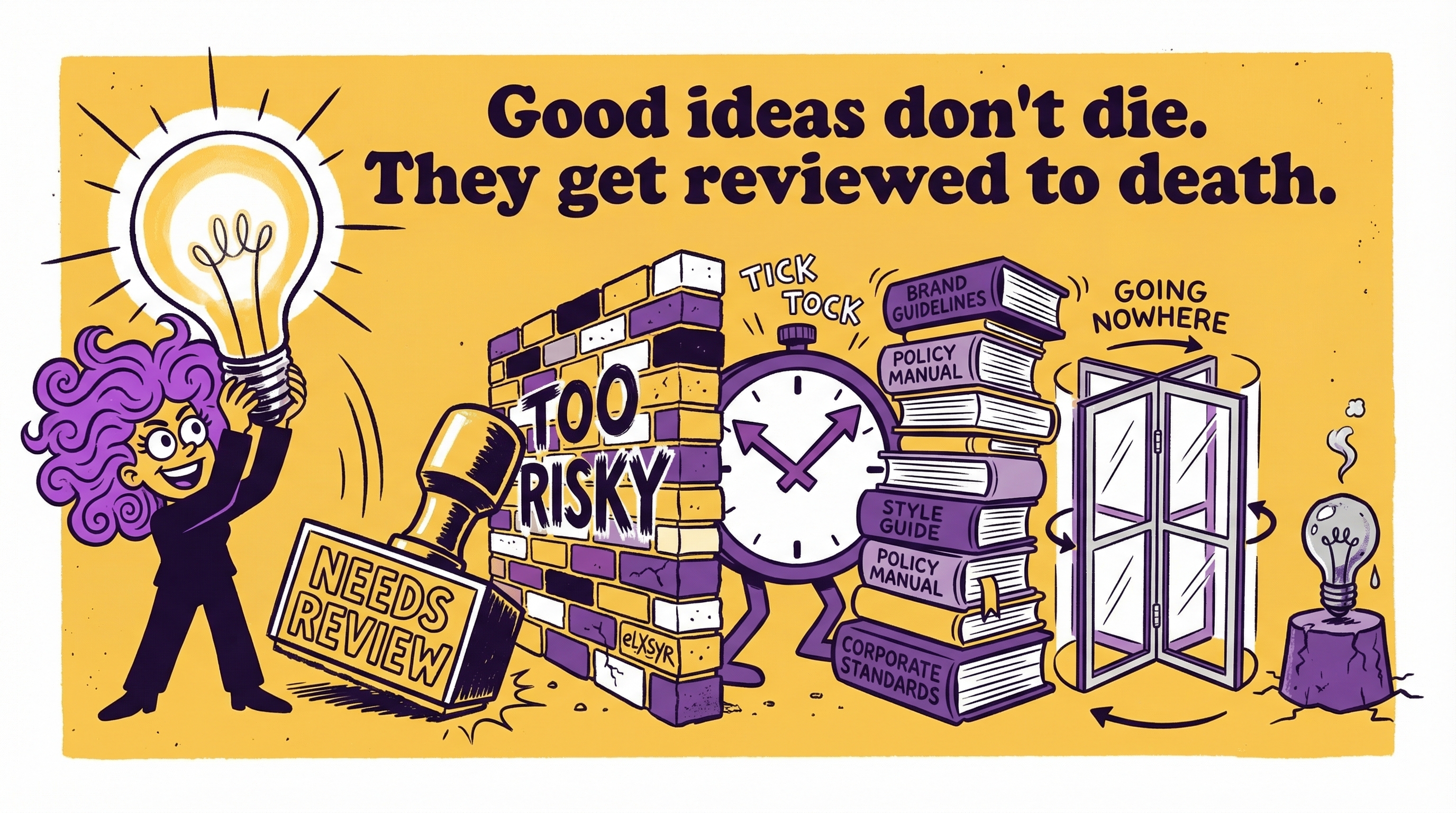
It is hard because good ideas have to survive real-world constraints: tight timelines, heavy reviews, risk concerns, and unclear standards. In that environment, innovation does not usually get rejected in one big moment.
It gets squeezed. It gets simplified. It gets delayed until the deadline forces a “safe” version.
I have felt that first-hand, and I have also seen it happen across teams and projects.
Here are the most common blockers, plus practical ways to work with them.
1) Innovation gets worn down by review cycles
A lot of innovation die during feedback, not during design.
The review process can become the main work. Small edits pile up. More people join the review. Feedback repeats. Worse, it often turns into a negotiation, "Can we do this instead?" Then the deadline hits and the “new” parts are the first to get cut.
What helps
- Start each review round with 1–2 clear questions, like: “Is this accurate and job-realistic?” “Will this help learners do X better?”
- Ask for consolidated feedback in one list per round, instead of scattered comments from many people.
- Keep a simple change log so decisions do not flip back and forth.
- Propose a clear review limit: “Two rounds, then we lock and ship.”
2) People want “new,” but they also want “safe”
Stakeholders often ask for engaging, modern learning. But when something feels unfamiliar, the first reaction is usually risk:
- “Will this confuse people?”
- “What questions will this raise?”
- “What if someone takes it the wrong way?”
That fear is not irrational. But if the default is “avoid risk,” innovation cannot survive.
What helps
- Turn vague risk into a specific question. Ask: “What is the exact risk?” and “What would it look like if it happened?”
- Pilot with a small group first, then scale based on what happens.
- Add guardrails when needed: short notes, policy links, or facilitator cues that prevent misunderstandings without killing the idea.
- Offer clear options instead of endless debate: “We can ship the safe version now, or pilot the improved version with one team.”
3) Innovation is judged like it should be perfect on day one
New approaches are often judged like final products, not pilots.
This is especially true for anything interactive, like branching scenarios, simulations, or AI-supported practice. Innovation needs iteration. If there is no space to test and improve, teams will choose predictable formats every time.
What helps
- Define what must be correct now (policy, safety, numbers) vs what can be improved after feedback (wording, pacing, optional features).
- Start small on purpose: one module, one scenario, one group.
- If AI is involved, use it for practice and coaching, not for final scoring. Keep critical checks in controlled formats.
- Bring examples and edge cases early, so quality concerns are handled upfront, not late.
4) Branding turns into a hidden time drain
Branding matters. Clear writing matters. A clean experience matters.
The problem is when branding becomes a repeatable time sink. If every project needs fresh design decisions, extra checks, and last-minute visual changes, the time that should go into testing and improving learning gets used up.
This happens in many teams. People second-guess fonts, colors, and layout, then try to match the standard after the learning design is already done. Sometimes a reference example is shared to speed things up, but if it is not turned into reusable templates and building blocks, it can still slow production because it creates replication work.
What helps
- Lock a small set of approved screen patterns early (title, content, scenario, knowledge check), then reuse them.
- Ask one clarifying question that saves time: “Is this a rule or a preference?”
- Create a small project “style kit” you can reuse inside the file: text styles, button styles, spacing rules, layouts.
- Make the brand check a template check first, not a full redesign at the end.
5) Time pressure kills the “extra steps” innovation needs
I have heard this many times:
- “This won’t get approved.”
- “This will take too long.”
- “We need this out soon.”
Innovation needs a little slack: time to test, revise, and measure.
When everything is urgent, those steps get cut first. So the output becomes fast and safe, but not always effective.
What helps
- Use “V1 now, V2 next”: ship the stable version, then plan one improvement cycle after go-live based on real feedback.
- Run small experiments inside normal work: change one piece, not the whole program.
- Track one signal that matters: fewer errors, faster proficiency, improved QA, fewer escalations.
What I wish more leaders understood
If you want innovation in L&D, asking people to “be more innovative” is not enough.
You need a system that protects it:
- review rounds that focus on the right thing at the right time
- clear rules for risk vs unfamiliarity
- templates and brand standards that reduce rework
- permission to pilot small, then scale what works
- metrics tied to performance, not just completion
Innovation is not only a creative problem. It is an operational problem.
A simple way to start this month
- Pick one real performance problem.
- Pilot one change with one group.
- Measure one result that matters.
- Decide fast: scale, revise once, or stop.
- Document what you learned so the next pilot is easier.
That is how innovation becomes normal, not rare.